How to Defend Yourself in Real-Life Situations: Practical Tips That Work
Self-defence advice on the internet is full of techniques that look great in videos and fall apart the moment someone resists. This guide skips the theory and gets straight to what actually works when you are under pressure and something feels wrong.
These are practical, real-world tips built around how real threats develop and not how they look in choreographed demonstrations.
Understand How Real Attacks Happen
Before you can defend yourself, you need to understand how most real attacks unfold. Films show long, drawn-out fights with warning signs and clear build-up. Real attacks are different.
Most street-level attacks are fast, close, and unexpected. They happen within arm's reach. The attacker often uses distraction first: asking the time, asking for directions, or starting a casual conversation. By the time the threat becomes obvious, the distance has already been closed.
This is why the best self-defence happens before any physical contact. The attacker's main advantage is surprise. Your job is to remove that advantage by staying aware and reading situations before they escalate.
Key things to know:
Most attacks happen within two metres
Many are opportunistic, not pre-planned
Attackers target people who appear distracted or unaware
Pre-attack cues exist, and you can learn to spot them

The Stages of Threat
Tip 1: Your Awareness Is Your First Weapon
The single most effective thing you can do to defend yourself is stay switched on in public spaces. This is not about being paranoid. It is about being present.
Practical awareness habits:
Keep your phone in your pocket when walking, especially at night
Know where the exits are whenever you enter a building
Trust your gut! If something feels wrong, act on it immediately
Make brief eye contact with people, it signals you are not distracted
Avoid headphones in both ears when walking alone
The moment you look like a distracted, easy target is the moment your risk increases. A switched-on person is a much harder target than someone staring at their phone.
Tip 2: Use Distance and Space Deliberately
Distance is your most valuable physical asset. The further someone is from you, the more time you have to respond.
If someone approaches you aggressively or makes you uncomfortable, create distance. Step back. Move to one side. Put a physical object between you and them if possible. Use the space to assess whether the situation is escalating.
A good rule: your personal space is roughly arm's length. If someone enters that space without your permission and you feel threatened, that is your signal to act, whether that means leaving, setting a verbal boundary, or preparing to defend yourself physically.
Do not stand still and wait. Move!
Tip 3: Use Your Voice Before Your Hands
A loud, clear verbal warning is one of the most effective tools you have. It serves three purposes:
It can stop the attack before it becomes physical: many aggressors back down when challenged directly
It draws attention from bystanders and witnesses
It signals to your own nervous system that you are taking action, which reduces freezing
The words matter less than the delivery. Loud, firm, direct. "Back off. Now." Not a question. Not an apology. A statement.
Practise this. Most people have never shouted assertively in a neutral situation, let alone an adrenaline-fuelled one. Your voice in training is very different from your voice under stress.
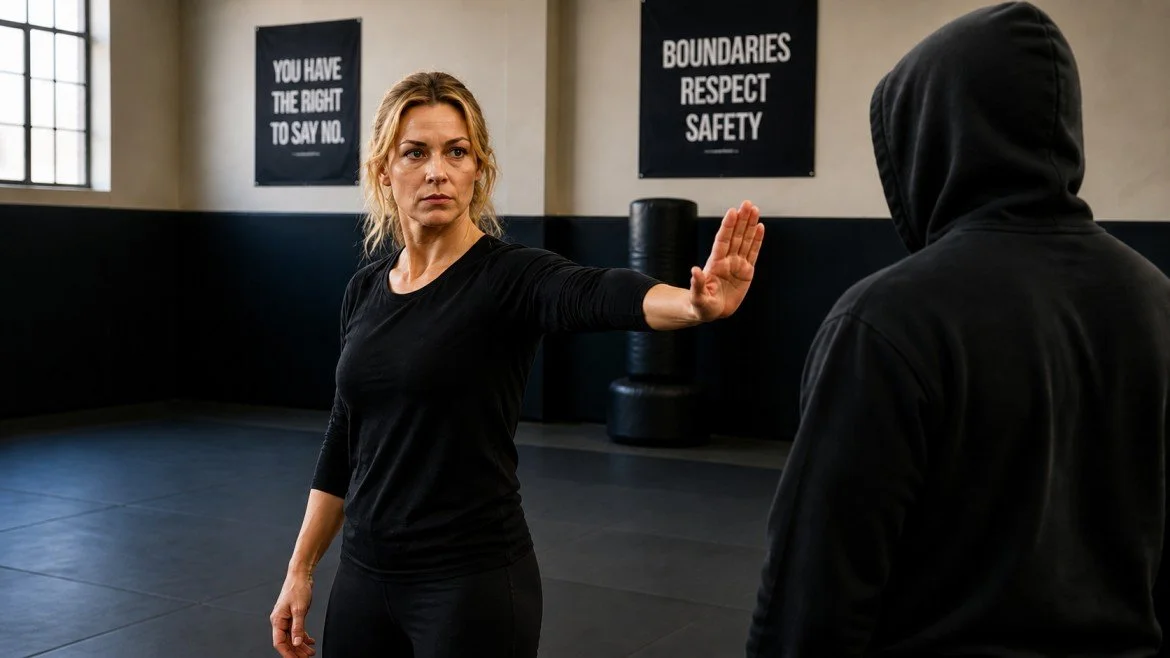
Person demonstrating a firm verbal boundary in a training scenario, arm extended in a "stop" gesture.
Tip 4: Target Vulnerable Areas
If a situation becomes physical and you have no other option, you need to act decisively. Do not try to overpower someone. Target vulnerable areas that work regardless of size difference.
The most effective targets:
Eyes, even a light finger jab causes involuntary watering and temporary vision loss
Nose, a palm heel strike to the nose causes immediate pain and disorientation
Throat, a strike to the throat disrupts breathing and is highly effective
Groin, effective against most attackers; a knee strike or kick to the groin causes immediate pain
Knees, a sharp kick to the side of the knee can compromise mobility and posture
You do not need to be strong. These targets are effective because they are physiologically vulnerable, not because hitting them hard is the goal.
Tip 5: Make Noise and Create a Scene
Silence helps attackers. Noise helps you.
In a public place, do not stay quiet to avoid embarrassment. Shout. Make as much noise as possible. Call for help explicitly, "Call the police!" is more effective than just screaming, because it gives bystanders a clear instruction.
In a vehicle or building, use the horn or an alarm. Anything that draws attention to the situation works in your favour.
This is uncomfortable to practise and even more uncomfortable to do in reality, which is exactly why it should be rehearsed in training.
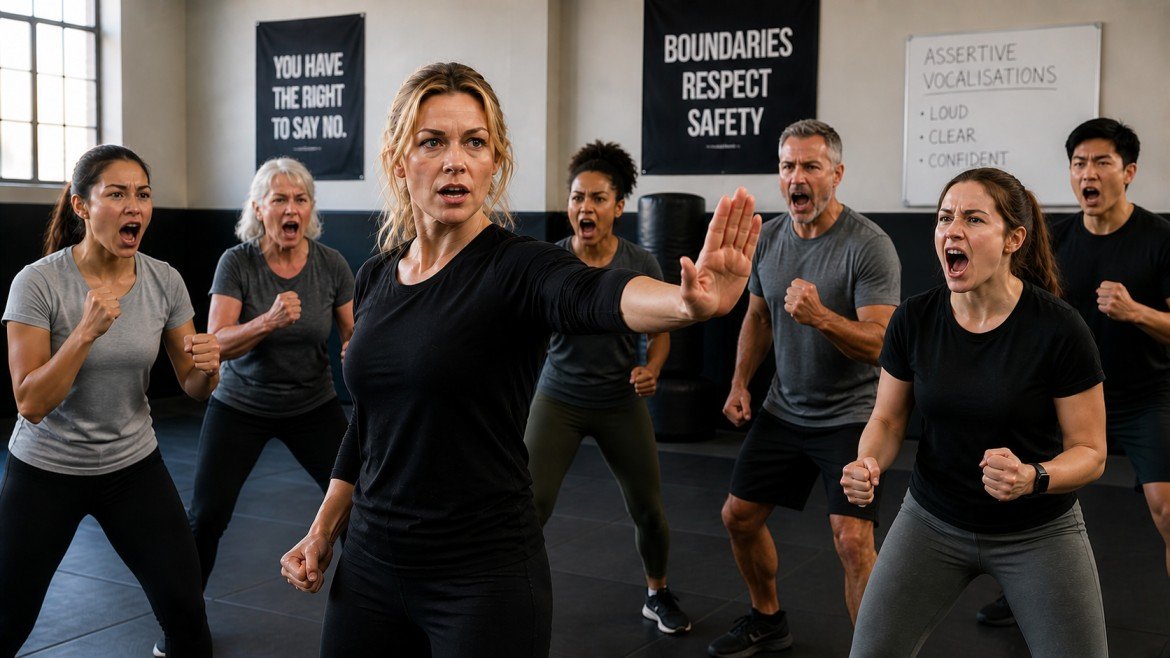
Self-defence class practising assertive vocalisations.
Tip 6: If You Go Down, Get Up Fast
Falls happen. If you go to the ground in a real confrontation, your priority is to get back to your feet as quickly as possible.
Staying on the ground during an attack puts you at a severe disadvantage. Most people have no ground-fighting training, and a standing attacker has a significant advantage over someone lying down.
Basic ground recovery:
Roll onto your side, not your back
Use your arms to push up, not just your core
Get one foot under you before coming up fully
Cover your head with your arms as you rise
This is a skill that should be drilled in training. It feels awkward at first but becomes quick and instinctive with practice.
Tip 7: Control the Aftermath
If you have successfully defended yourself and the threat has gone, your work is not over.
In the aftermath:
Move to a safe location immediately
Call the police if an attack took place
Do not pursue the attacker
Find witnesses and note their details if possible
Keep a record of what happened as soon as you can while the memory is clear
Understanding the legal context matters too.
In the UK, you have the right to use reasonable force in self-defence. "Reasonable" means proportionate to the threat. Training at us at M-Power Krav Maga includes guidance on this, so you understand your rights as well as your skills.
FAQ: Defending Yourself in Real Situations
What if the attacker is bigger and stronger than me?
Size and strength matter less than you think when you target vulnerable areas and act decisively. Self-defence is not about overpowering someone. It is about creating enough disruption to escape. A strike to the eyes, throat, or groin is effective regardless of how big someone is.
Should I fight back or comply?
This depends entirely on the situation. If someone wants your phone or wallet, handing it over is usually the safest choice. If someone is physically threatening your safety or trying to move you to a secondary location, that changes the calculation significantly. Training helps you make these distinctions quickly.
How do I stop freezing under pressure?
Freezing is a natural adrenaline response. The best way to reduce it is to rehearse decision-making under stress in training. Scenario-based drills condition your brain to act even when adrenaline hits. You cannot eliminate the freeze response entirely, but you can shorten it dramatically through regular practice.
Are self-defence classes worth it?
Yes, especially for practical scenario-based training. Reading books or watching videos is not the same as drilling techniques with a partner. The physical repetition and the stress inoculation you get from training are things you cannot replicate on your own.
What is the most important self-defence skill?
Awareness. The ability to spot a threat before it becomes physical gives you time, and time is everything. Most self-defence situations can be avoided entirely by people who are switched on and trust their instincts.
Start Training!
Reading this guide gives you a framework. Training makes it real. You will not develop reliable self-defence skills by reading articles. You develop them by drilling techniques, practising scenarios, and building the physical and psychological reflexes that work when your heart is racing.
M-Power Krav Maga runs practical self-defence classes in Reading, covering the techniques and awareness skills in this guide. Try a class and find out how much you can learn in a single session.
or